Electrification
Demand patterns are changing as heat, transport, industry, and AI data centers connect to the grid.
 Hypernode LabsGet in touch
Hypernode Labs builds the intelligence layer for energy systems, enabling faster, more accurate, and scalable operational decision-making for grid operators.
The current grid reality
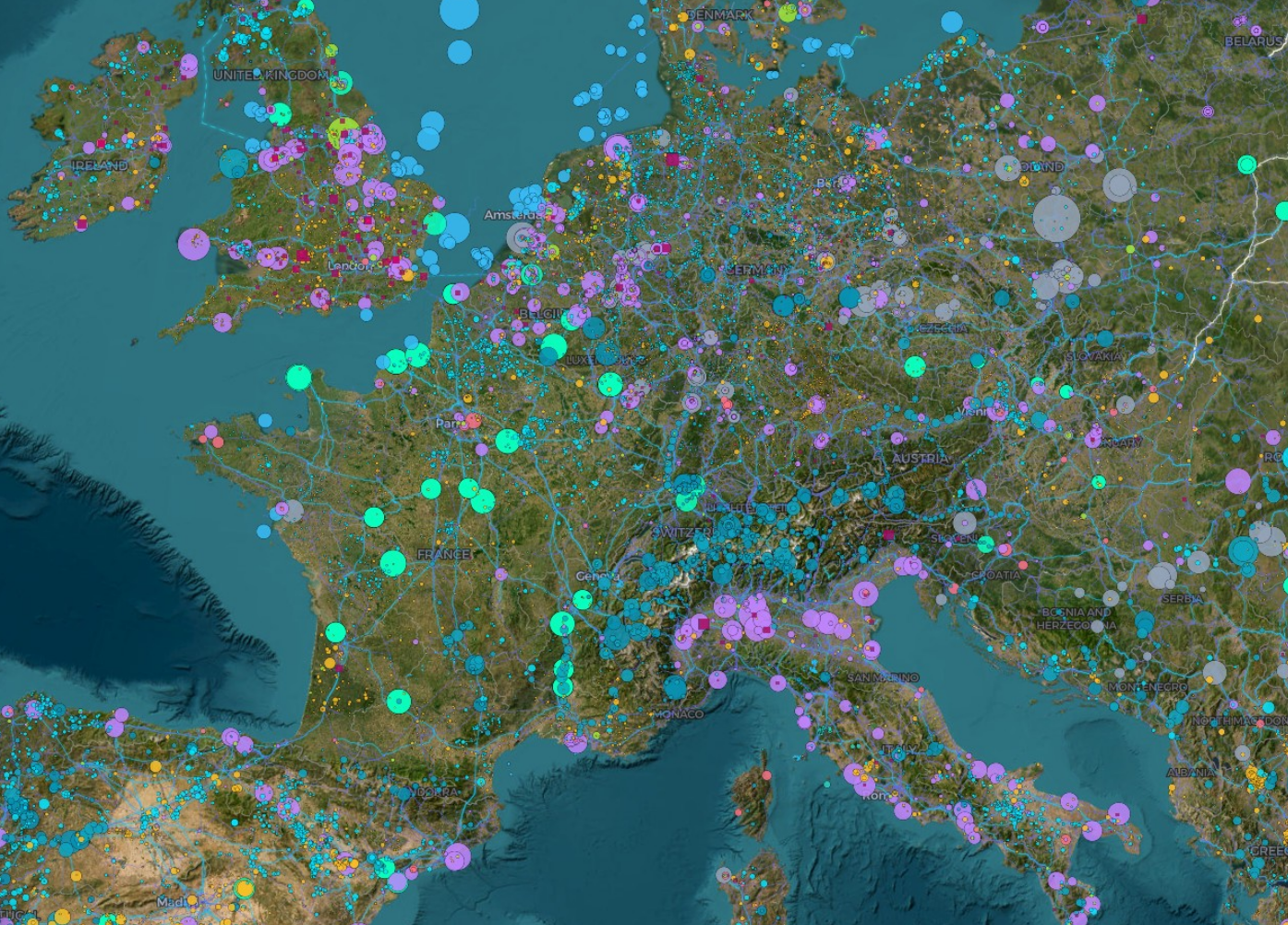
The European grid illustrates why operational intelligence must reason across topology, physics, uncertainty, and constraints at continental scale.
Demand patterns are changing as heat, transport, industry, and AI data centers connect to the grid.
Connection queues and operating constraints are becoming a board-level issue for grid operators, industry, and customers.
Operators need better decisions before congestion-management costs compound into double-digit billions.
Existing workflows were not designed to evaluate thousands of contingencies, actions, and uncertainty states fast enough for modern operations.
Why existing tools fail
Thousands of substations, lines, constraints, contingencies, and remedial actions interact across time.
Weather, renewables, demand, outages, and markets move faster than deterministic workflows can absorb.
Planning, forecasting, security assessment, and dispatch still rely on disconnected tools and manual handoffs.
The Hypernode platform
SCADA/EMS snapshots, topology, asset status, weather, and market context.
Curated and anonymized representations that preserve sovereignty.
Models that learn grid physics, topology, and operational behavior.
Power flow, scenario generation, market, weather, and decision-support engines.
Congestion management, security assessment, forecasting, and operational planning.
Explore thousands of weather, demand, market, and topology states.
Screen operating limits, flows, and constraints at model speed.
Compare topology, redispatch, and flexibility options with technical and cost-benefit context.
Why foundation models
Capture topology, constraints, and physical system behavior instead of treating the grid as a generic dataset.
Train and fine-tune from synthetic representations without requiring operators to share sensitive grid data.
Run simulations at AI inference speed, so operators can explore uncertainty before acting.
Applications
Evaluate remedial actions, topology changes, costs, and operational feasibility across thousands of scenarios.
Screen contingencies and system states with fast model-assisted analysis.
Combine weather, renewables, load, and grid state to support operational foresight.
Bridge planning and control-room workflows with consistent model infrastructure.
Early validation
About
The company is rooted in Delft AI Energy Lab and 15+ years of power-system and AI research.
Proof-of-concepts were developed in the lab and are now being translated into reliable operator-facing products.
Methods are validated in collaboration with Alliander and TenneT, with a focus on practical grid-operation workflows.
Vision
Hypernode Labs aims to become a trusted foundation-model platform for the energy ecosystem, enabling operators to plan, forecast, and operate increasingly complex grids with infrastructure-grade models and practical deployment paths.
Contact